Handcrafted Notes | Why Messy Human Ones Beat Generated Ones
Screenshots of raw, typo-laced Markdown are being posted as a badge of honour. What is actually true in that, what is posturing, and how to set up a desk where nothing writes for you.
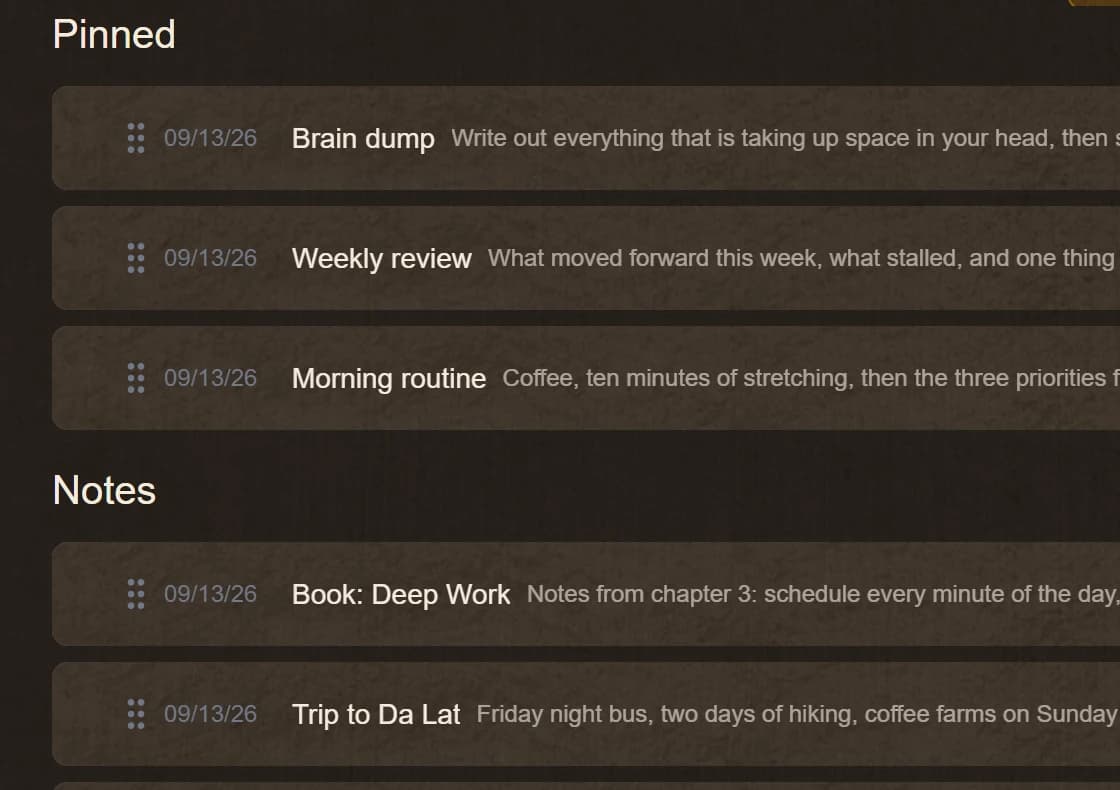
There is a specific kind of screenshot going round: someone's raw notes file, full of abbreviations, strike-throughs, a heading typed twice, three bullets that contradict each other, and a line in capitals that says CHECK THIS. It gets posted with something like "no AI was harmed in the making of this thought".
A year ago that file would have been embarrassing. Now it is a flex.
The reason is that fluent prose stopped being evidence of anything. Anyone can have five clean paragraphs in a second, so five clean paragraphs prove nothing about whether a person understood the subject. A messy note still proves it, because nothing produces that particular mess except a human being working something out.
Underneath the posturing there is a real argument, and it is worth separating from the posturing, because both are in there.
Slop is a description, not an insult
The word arrived because people needed one. "AI slop" is text that is grammatical, on topic, confident and empty: the statistical middle of everything already written about a subject, delivered in a tone of mild authority.
What makes it slop is not that a model produced it. It is that nobody decided anything. No claim was chosen over another claim, no example was preferred because it was the better example, nothing was cut because it was weak. The result reads like an average, which is exactly what it is.
That matters for public writing, and it matters more for the notes nobody else will read, because notes are where the deciding is supposed to happen.
The part of the argument that is true
Writing something down is not transcription. It is the moment a vague impression is forced to become a sentence, and the moment you find out whether you actually understood it.
There is a well-documented effect behind this. Material you produce yourself is remembered better than the same material read, which psychologists call the generation effect, and it does not depend on a pen: typing a summary in your own words beats reading someone else's. The benefit comes from the effort of retrieval and choice, not from the handwriting.
So when a tool writes the summary for you, three things happen at once.
The recall never forms. Reading a generated recap produces recognition, which feels like understanding and disappears within a day or two. You notice the difference the next time someone asks a question one layer below the summary.
The odd detail gets smoothed away. The reason you wrote a note down is usually the one thing that did not fit: the objection, the strange number, the thing the client said in passing. A model rounds towards the expected, because that is what it was trained to do. What comes back reads well and has lost the point.
Your hypothesis drifts to the middle. An autocomplete that finishes your sentence finishes it the way most people would. That is fine for an email and corrosive for a thought that was going somewhere unusual.
| Generated for you | Written by you | |
|---|---|---|
| Time to a finished page | Seconds | Much longer |
| What you have afterwards | A document | A document and an understanding |
| The unusual detail | Smoothed towards the expected | Still there, still awkward |
| Time to verify it | Hours, and easy to skip | Already done while writing |
| Recall two days later | Recognition, fading | Retrieval, durable |
The last row is the whole case. Everything above it is about the page; that row is about you.
The part that is posturing
Taken literally, the handcrafted flex becomes its own performance, with people competing over how raw their setup is. Three things it gets wrong.
Typos are not virtue. A messy note is evidence of thinking, not a cause of it. Leaving errors in on purpose so the file looks authentic is the same vanity as polishing it, pointed the other way.
Not every job is thinking. Converting a table, finding the paragraph you half remember, checking a date, turning a transcript into a list of who said what: these are chores. Handing them to a model costs you nothing, because there was no understanding in them to lose. The rule that survives is narrower than the slogan: do not outsource the step where you decide what you think.
A folder of rough text is not a system. Plain notes have no board, no reminder, no view of the week. For capture that is the point; for work with dates and dependencies, structure is why the tool exists. The honest version of the argument is about the writing step, not about refusing organisation, which is roughly where digital brutalism lands too.
Setting up a desk where nothing writes for you
Most editors are now mildly hostile to a person trying to compose a sentence. You pause, a grey ghost appears; you select a line, a toolbar offers to make it more professional. Each of those costs a small decision to refuse, and there are dozens in an afternoon.
Turn off inline suggestions first. Not the assistant in general, the ghost text specifically. It is the one that interrupts composition rather than waiting to be asked, and in most apps it is a single switch. If it cannot be switched off, the question has become which app you use, and that is the subject of a notes app without AI.
Write in Markdown. A dash for a list, a hash for a heading, two asterisks for emphasis. No formatting wizard has an opinion about your paragraph, and what you typed is what is stored.
Separate capture from filing. A first note is a scratchpad, not a record. If the tool demands a title, a tag and a folder before it will accept text, you will stop writing things down. The daily note solves the filing by default: the date is the filing.
Let most of it die. The value was in writing it, not in keeping it. A weekly pass that deletes whatever you have skipped twice is worth more than any archive, which is the case for disposable notes.
Decide when a model reads your writing. Keeping the assistant out of the app does not mean never using one. It means copying a paragraph into it deliberately, having decided that it helps, rather than having a model read everything by default. The version of this argument that is about where your text goes rather than how you think is in is my notes app training AI on my notes.
Where we sit, honestly
TaskNote is ours, so treat this as a description rather than a review.
The Windows app has no assistant. Nothing completes your sentence, nothing offers to summarise the page, and no model reads what you type. There is no account and no sync: the window opens over whatever you were doing on a hotkey, and on the machine this was written on it is up in about nine tenths of a second from cold. Text is Markdown and exports as .md files into a folder, so nothing you write is trapped in our layout. When a line turns out to be work, it becomes a card on a local kanban board instead of a new obligation to file something.
Three things we will not dress up.
Your notes are not plain files on disk. They are rows in a SQLite database beside the app, which is what makes search and the board fast, and the export is how you get .md files out. It is not an encrypted vault either: it is a plain database, which is the right trade for speed and for working with no account, and the wrong one against somebody with access to your machine. If that is your threat, the web app encrypts notes on your device before they reach us.
There is one place where a machine produces text in the app, and it deserves naming rather than hiding: the dictation button, which hands your voice to the speech recognition built into the browser engine the window is drawn with. It writes down what you said. It does not decide what you meant, which is the distinction this whole piece rests on, but it is not nothing, and it is a button you never have to press.
And "no assistant" is a promise about today that we intend to keep, not a law of physics. The reason to prefer a quiet tool is not that its makers are virtuous; it is that you can check the interface yourself, and it takes about ten seconds: open a blank note and count what appears uninvited.
The short version
The useful half of the handcrafted flex is this. Fluent text is no longer evidence of thought, so the only thing that still demonstrates understanding is the record of having done the work, and the work is the writing. Keep the friction where the thinking is, remove it everywhere else, and judge a note by whether you could defend it two days later without reopening it.
Then stop reading about note taking and go write the awkward, unfinished, entirely yours version of whatever you were about to look up.
Questions
- What is AI slop?
- Text, images or posts generated in bulk with no particular author behind them: fluent, on topic, and empty. The word caught on because feeds filled with writing that reads like an average of everything already said, and readers learned to recognise the texture before they could explain it.
- Does writing notes yourself help you remember better than generating them?
- Producing something yourself is remembered better than reading the same thing, which psychologists call the generation effect, and it holds whether you type or write on paper. The gain does not come from the handwriting. It comes from having to decide what the sentence says.
- Is it bad to use AI for note taking?
- Not by itself. It is bad when it replaces the step where you work out what you think, and useful when it does a job you have already thought through: finding a passage, converting a format, checking a fact you will verify. The line is whether you could defend the note without the tool.
- Why are people posting screenshots of messy notes?
- Because a rough note is evidence of a mind at work and a polished page no longer is. When anyone can produce clean prose in a second, the unpolished version becomes the thing that is hard to fake, which is how it turned into a small badge of honour.
- How do I turn off AI in my notes app?
- Look in settings for assistant, copilot or predictive text, and switch off inline suggestions first, since those are the ones that interrupt. If the feature cannot be turned off, the question stops being a setting and becomes which app you use.
aiwritingminimalism