What is End-to-End Encryption (E2EE)?
TL;DR:
End-to-End Encryption (E2EE) is a secure communication method where data is encrypted on the sender's device and can only be decrypted on the recipient's device. No third parties, including internet providers, hackers, or even the app developers themselves, can access the unencrypted content because they do not possess the decryption keys.
The Real-World Analogy
To understand E2EE, imagine sending a message to a friend.
- Standard Encryption (Like Notion or Gmail): You write a message on a postcard. You hand it to the mailman. The mailman promises not to read it, but legally or technically, he can read it because the text is visible. When it arrives at the post office, they might photocopy it for "storage" before delivering it.
- End-to-End Encryption (Like TaskNote): You write a message, put it inside a solid steel safe, and lock it with a key that only you and your friend possess. You send the locked safe through the mail. The mailman can weigh the safe, shake it, or try to smash it, but he absolutely cannot read the message inside.
How It Works Technically
In most standard web applications, data is protected by Encryption in Transit (SSL/TLS) and Encryption at Rest. This means your data is safe while traveling through the internet, but once it reaches the company's server (e.g., Google or Evernote), the server decrypts it to process it.
In an E2EE system, the process is fundamentally different:
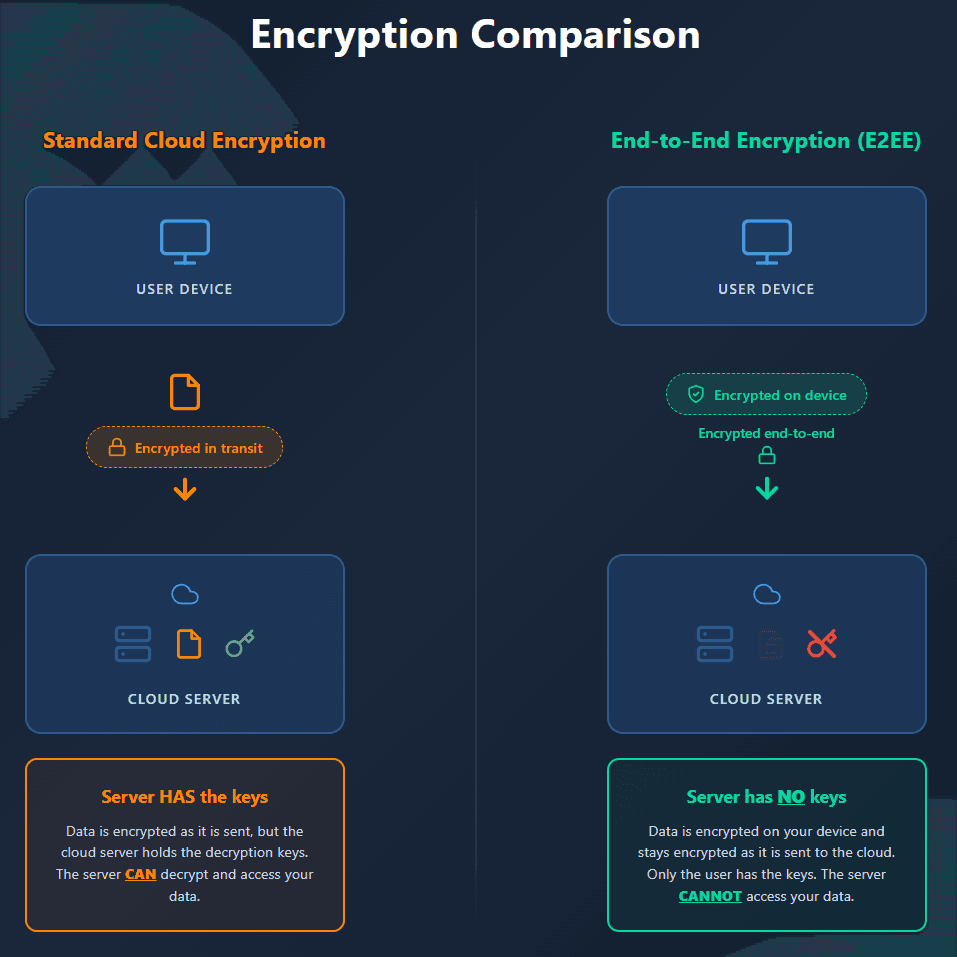
- Key Generation: Cryptographic keys (Public and Private) are generated locally on your device.
- Local Encryption: Before you hit "Save," your data is turned into meaningless ciphertext directly on your device.
- Transmission: The server receives only this encrypted "noise." The server has no mathematical way to interpret the data.
- Decryption: The data is only turned back into readable text when it reaches your other device, which holds the matching encryption key.
Why It Matters
If an app does not use E2EE, your data is vulnerable to two major threats:
- Data Breaches: If hackers breach the company's servers, they steal the database and the keys to decrypt it. Your private notes become public.
- Unauthorized Access: Without E2EE, database administrators, rogue employees, or AI algorithms scanning for "policy violations" can technically read your private journals or code snippets.
With E2EE, a server breach yields nothing but useless, scrambled code.
How TaskNote Uses E2EE
We built TaskNote on a Zero-Knowledge architecture.
Unlike popular cloud-based productivity tools, we utilize strict Client-Side Encryption. Your account password is used to derive an AES-256 encryption key solely on your device. This key never leaves your computer or phone. When syncing, we only transfer encrypted binary blobs.
This means that even we, the developers of TaskNote, cannot read your notes, even if we wanted to or were compelled by law enforcement.
Frequently Asked Questions (FAQ)
If I lose my password, can you recover my notes?
No. Because we use E2EE and do not store your encryption keys, we have no "master key" to reset your password. If you lose your password and your Recovery Key, your data is mathematically inaccessible forever. This is the trade-off for total privacy.
Does E2EE make the app slower?
In web-based apps, it might. However, TaskNote is Local-First. All encryption and decryption happen instantly on your device using your processor's native power, so the app feels significantly faster than cloud-based alternatives.
Does E2EE protect me from viruses?
No. E2EE protects data during transmission and cloud storage. If your computer is infected with malware (like a keylogger), hackers might capture your keystrokes before they are encrypted. Always keep your device secure.