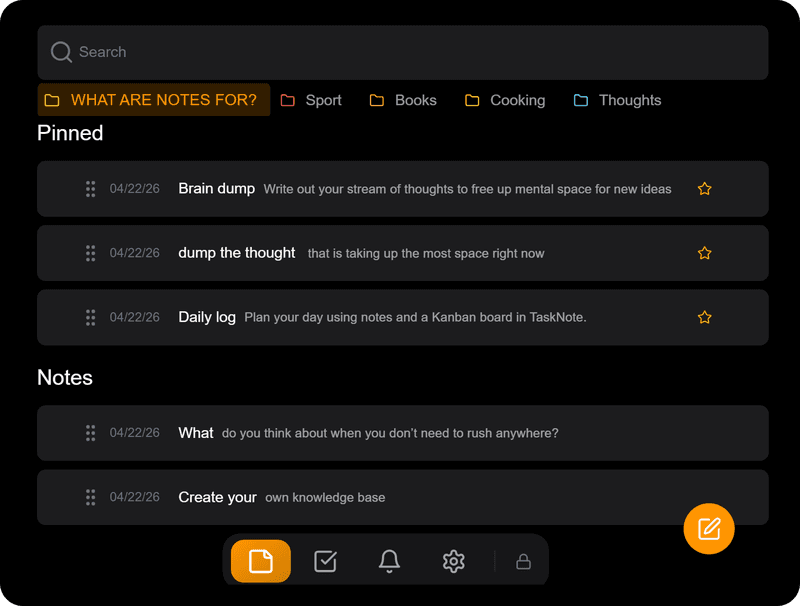

TL;DR: A brain dump is ten minutes of writing down every thought, task and worry in your head, in no order, until nothing is left. It works because remembering costs attention, and paper is cheaper than memory. Below: why it helps, five steps, 30 prompts to get you started, when to do it, and how to turn the list into something you can act on.
A brain dump is the practice of writing down everything that is on your mind, unsorted and unedited, until your head is empty. Tasks, half-ideas, worries, things you keep meaning to look up, the name you cannot place. Nothing is organised while you write. Sorting comes later, if at all.
It is the simplest mental clarity practice there is, and the one most people skip because it sounds too easy to matter. It matters. If you have ever lain awake running through tomorrow, or felt tired at noon without having done anything hard, you have felt the overwhelm of carrying unfinished things in your head. A brain dump puts them down.
Why a brain dump works
Your working memory is small. Most estimates put it at four to seven items, and every unfinished task you are holding takes one of those slots. Psychologists call the pull of unfinished tasks the Zeigarnik effect: the mind keeps them active, like a tab you never closed, so they surface at odd moments and drain attention you wanted for something else.
Writing them down closes the tab. In a 2011 study, Masicampo and Baumeister found that simply making a plan for an unfinished task freed people to concentrate on other work, even before the task was done. The mind stops rehearsing what it knows is recorded somewhere.
A 2021 study on students found that a short brain dump before a lesson, four questions answered in writing, lowered intrinsic cognitive load: the mental effort of holding material in mind. Less load, more attention left over, calmer head. That is the whole mechanism, and it needs no app, only the habit.
Sources: Masicampo & Baumeister, Consider It Done! (Journal of Personality and Social Psychology, 2011) · Handayanie et al., Brain Dump Activities to Overcome Students' Intrinsic Cognitive Load (JPMIPA, 2021) · Zeigarnik effect
How to do a brain dump, step by step
Ten minutes, one page, no editing. That is the entire method.
1. Pick one surface
Paper, a notes app, the back of an envelope. What matters is that everything lands in one place. Splitting a dump across sticky notes and three apps recreates the problem you are trying to solve.
2. Set a timer for 10 minutes
The limit is what makes this different from journaling. You are not reflecting, you are emptying. A timer stops you from polishing the first three items and never reaching the twentieth, which is usually the one that was keeping you up.
3. Write everything, in any order
Tasks, ideas, worries, questions, names, the thing you promised someone. Do not sort, do not judge, do not decide whether an item is worth writing. If it is in your head, it goes on the page. Short fragments are fine; full sentences slow you down.
4. When you stall, use a prompt
The first thirty seconds pour out. Then you stall, and the stall is where the useful items hide. Ask yourself a prompt from the list below and keep going. Stop when the timer stops, not before.
5. Read it back once
One pass, without a pen. You will notice that most items are smaller than they felt, a few are not yours to carry, and two or three actually need a next step. Those go into the sorting step at the end of this guide. The rest can stay on the page.
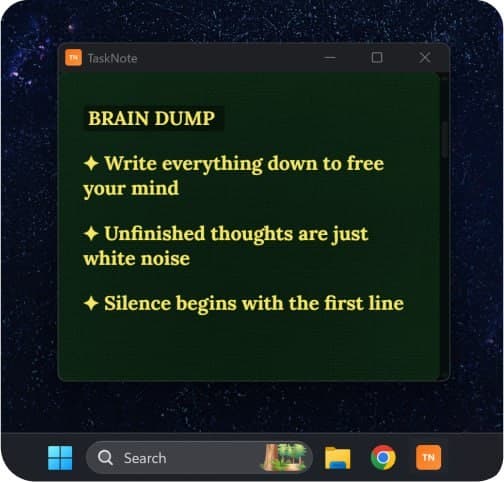
30 brain dump prompts
Use these when the page goes quiet. You do not need all of them; pick the group that matches the moment.
Work and tasks
- What did I say I would do this week?
- What am I avoiding, and what is the smallest first step?
- Who is waiting on me?
- Which meeting do I still need to follow up on?
- What would I finish today if nothing interrupted me?
- What is on my plate that should not be?
- What do I keep re-reading instead of deciding?
What is looping in my head
- What thought keeps coming back?
- What am I worried will happen?
- What conversation am I replaying?
- What decision have I been postponing?
- What am I angry about that I have not said?
- What would I tell a friend in my situation?
- What is true, and what am I only imagining?
Life admin
- What needs booking, renewing or paying?
- What is broken at home?
- Whose birthday is coming?
- What did I mean to look up?
- What am I running out of?
- What have I borrowed or lent?
- What appointment am I overdue for?
Ideas and wants
- What idea have I had three times now?
- What would I do with a free afternoon?
- What do I want to learn?
- What am I curious about lately?
- What did I enjoy this week?
- What would make next week easier?
- What am I grateful for?
- What do I want less of?
- What do I want more of?
When to do a brain dump
Once a week is enough to feel the difference. Once a day is where it becomes a tool rather than a rescue. These are the four moments where it earns its ten minutes.
First thing in the morning
Before email, before the phone. Whatever the night left behind comes out first, and the day starts from an empty page instead of from yesterday's leftovers. I do mine with coffee, and it is the reason I no longer open the laptop already behind.
When you cannot fall asleep
The classic case. Lying in the dark rehearsing tomorrow is a brain dump you are doing in your head, badly. Doing it on paper, or in a note on the phone, takes five minutes and usually ends the loop. Keep something to write on within reach of the bed.
After a meeting or a hard conversation
You leave with commitments, impressions and three things you meant to say. They evaporate within the hour unless written down. A two-minute dump straight afterwards catches all of it, and is the fastest meeting notes you will ever take.
The Sunday reset
A longer one, fifteen or twenty minutes, at the end of the week. This is the dump that feeds the next week's plan: everything comes out, then the sorting step below turns it into a short list of what actually matters.
Related reading: My experience: why I unload my thoughts when there is an emotional storm inside · ADHD brain dump: getting the forty tabs out of your head
Brain dump, journal, to-do list: what is the difference
They overlap, and people use the words loosely. The difference is in what you do while writing.
| Brain dump | Journal | To-do list | |
|---|---|---|---|
| Goal | Empty the head | Understand a feeling or a day | Track what to do |
| Time | 10 minutes, timed | As long as it takes | Ongoing |
| Order | None | Narrative | By priority or date |
| Editing | Never while writing | Sometimes | Constantly |
| What you keep | Only what needs a next step | The entry | Everything until done |
A brain dump usually feeds the other two. The worries become a journal entry if they need one; the commitments become tasks. On its own, it is neither. It is the emptying that comes first.
What to do after a brain dump
A dump only helps if the items that need action leave the page. Read the list once and put each item into one of four piles. Most go into the last one.
Tasks. Anything with a next step and a deadline. Give it a date and a place where you will see it. This is where a brain dump becomes a plan.
Notes. Ideas, references, things to remember but not to do. They need a home you can search later, not a spot on a task list where they will nag you.
Reminders. Things that matter on a particular day and not before: a renewal, a call, a check-in. A reminder holds them so your head does not have to.
Let go. Worries with no action, other people's problems, ideas you have written down for the third time and will not pursue. Leaving them on the page is the point. You wrote them so you could stop carrying them.
The same sorting works for anything you are trying to change. When I stopped drinking coffee, the dump was full of the ritual around it, not the drink: the grinder, the smell, the first warm cup. Written down, it was obvious the ritual was the thing to keep, and warm water with lemon took its place. The habit changed without a fight because the real want had a name.
In TaskNote the sorting happens inside the note you dumped into: a line becomes a task, a task gets a due date, a reminder is set without leaving the page, and the rest stays where it is, searchable and encrypted on your device. See how the brain dump flow works in TaskNote
Four mistakes that make it feel useless
Sorting while writing. The moment you start deciding where an item belongs, the flow stops and the quieter thoughts never surface. Write first. Sort after, and only what needs it.
Stopping at the first pause. The first minute is easy. The items that were actually weighing on you come after the stall. That is what the timer and the prompts are for.
Treating the list as a to-do list. A dump of forty items is not a plan for forty things. Most of it is meant to be released, not done. If you try to act on all of it, the practice becomes another source of pressure.
Doing it once and expecting it to stick. One dump clears the head for a day. The calm comes from the rhythm: a short one most mornings, a longer one at the end of the week.
Brain dump FAQ
How long should a brain dump take?
Ten minutes is the standard, and the timer is part of the method. A weekly reset can run to twenty. Longer than that and you have drifted into journaling, which is fine, but it is a different exercise.
Is a brain dump the same as journaling?
No. Journaling explores a feeling or a day and takes as long as it takes. A brain dump is timed, unsorted and aims only to empty the head. The two work well together: the dump first, then a journal entry if something in it needs thinking through.
Does a brain dump help with anxiety?
For the everyday kind, the looping, the lying awake, yes: research on cognitive load and on unfinished tasks both point the same way, and most people feel the difference on the first try. It is not a treatment for an anxiety disorder, and it does not replace one.
Paper or an app?
Whichever you will actually reach for at eleven at night. Paper has no distractions; an app is searchable, always with you, and lets a line become a task in place. Many people dump on whatever is nearest and sort in an app afterwards.
What do I do with the list afterwards?
Read it once and sort it into four piles: tasks that get a date, notes that get a home, reminders that get a day, and everything else, which you leave on the page on purpose. Then close it. The next dump starts from a blank page, not from this one.
Your head is not a good place to keep a list. It was never meant to be one. Ten minutes, one page, and the noise has somewhere else to live.
If you want a place for the sorting that keeps notes, tasks and reminders together, TaskNote was built around exactly this flow.
Recent articles

Comments
Public discussion. Submissions are moderated before they appear.
Loading comments…