
ADHD · BRAIN DUMP
ADHD brain dump: getting the forty tabs out of your head
A brain dump is writing out everything in your head in one go, with no order and no editing. People with ADHD often describe working memory as a browser with forty tabs open. Getting the contents onto paper or a screen means you stop spending energy just to avoid forgetting.
There is a particular kind of tired that has nothing to do with how much you did. It comes from holding things in mind: the appointment on Thursday, the email you owe someone, the thing you promised yourself you would look up, the worry you cannot name yet.
None of it is work. All of it takes room. A brain dump is the plainest way to put that room back.
What a brain dump actually is
You take a blank page or an empty note and write down everything that is currently taking up space. Tasks, worries, half-formed ideas, things you keep meaning to look up, the film someone recommended. No categories, no order, no fixing the spelling.
The point is not to end up with a good list. The point is to stop holding it. What you get afterwards is a messy pile you can look at, which turns out to be much easier to deal with than the same pile inside your head.
Why people with ADHD reach for it
- It frees up working memory. The forty-tabs description comes up constantly for a reason. Once the contents are written down, your head is no longer running a background process whose only job is not forgetting.
- It makes the pile finite. A vague cloud of everything-I-should-be-doing has no edges. Eleven lines on a page do. The same load looks smaller once it stops being a feeling and starts being a list.
- It helps when you cannot start. Not knowing where to begin is not laziness, it is having too many candidates at once. Seeing them side by side makes picking one possible.
- It works at two in the morning. The thoughts that arrive when you are trying to sleep are exactly the ones a brain dump is for. Writing them down is what lets you put them down.
None of this is treatment, and a brain dump does not replace anything you do with a professional. It is a habit that a lot of people find useful, and it costs ten minutes and a piece of paper to try.
How to do one in ten minutes
- Get something to write on: a blank sheet, or an empty note on the screen.
- Set a timer for five to ten minutes, so the thing has an end and you are not deciding when to stop.
- Write with no rules. Do not correct the spelling, do not put anything in order, do not judge what comes out.
- Empty the corners too. Chores, big things at work, small worries, stray reminders, all in the same place.
- When the timer goes, stop. If you are still going, that is what tomorrow is for.
A trigger list for when you go blank
Two minutes in you will probably run out. That is normal, and it does not mean your head is empty. Run through these and see what shakes loose:
- Home. Repairs, bills, things that ran out, the drawer you keep meaning to sort.
- Work. Deadlines, replies you owe, the thing you said you would look into.
- People. Calls, birthdays, someone you have been meaning to check on.
- Health. Appointments, prescriptions, the ache you keep noticing.
- Money. Payments, subscriptions you forgot you had, something you meant to cancel.
- Someday. Ideas, places, things you want to learn. They take up room too.
What to do with it afterwards
- Group what is similar. Urgent, later, and things you can cross out because they never needed your time.
- Pick two or three for today. Not ten. The list exists so you can choose, not so you can do all of it.
- Give the rest a date or let it go. Anything without a date goes back to living in your head, which is the thing you were trying to stop.
Paper or a screen
Paper is faster to start and there is nothing to set up. Writing by hand is slower, which some people find helps them get further down the pile.
A screen wins afterwards. You can find a dump by search months later, put a reminder on one line, and keep everything in one place instead of across four notebooks. If you keep losing the paper ones, that is the argument.
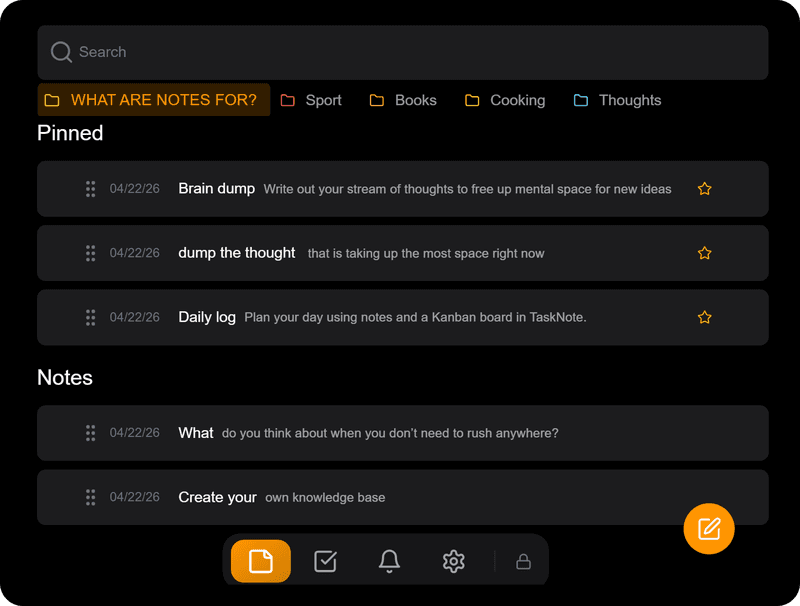
Doing it on a computer? There is an app built for the dump
Common questions
What is a brain dump for ADHD?
It is the same practice as any brain dump, done with no filtering, no organising and no judgement, usually when working memory feels overloaded. You write out every task, worry and stray idea in one go so your head stops holding them.
How long should it take?
Five to fifteen minutes is the usual range. Five suits a quick daily reset, ten to fifteen is the sweet spot when things have piled up. Twenty to thirty makes sense if you have not cleared your head in weeks. Stop when the timer goes so you do not sit there spinning.
How often should I do one?
Most people settle on once a week. Some prefer a short one in the morning or before sleep. Try both and keep whichever leaves your head clearer, rather than the one that feels more virtuous.
What if I go blank halfway through?
That is what a trigger list is for. Run through categories like home, work, people, health, money and someday, and see what comes up. Going blank usually means you have run out of what is on the surface, not that there is nothing underneath.
Do I need an app for this?
No. Paper works. An app earns its place afterwards, when you want to search an old dump, set a reminder on a single line, or keep every dump in one place.
Ten minutes and a blank page. That is the whole method.
How full is your head right now?
Six questions · about a minute
How often do you catch yourself repeating something in your head so you will not forget it?
Recent articles

Comments
Public discussion. Submissions are moderated before they appear.
Loading comments…