
There is no best note-taking method, only a method that fits what you are doing. Here are seven, what each is good at, and where each one falls apart.
I build a notes app for a living, which means I spend a lot of time watching people fight their own notes. The pattern is almost always the same: the app is not the problem. The method is.
Most people never chose a method. They open a blank page and type until the meeting ends, then never look at it again. That is not note-taking, that is transcription with extra steps. A method is simply a decision made in advance about what you will write down and how you will find it later.
Below are seven that have survived contact with real use. I have marked where each one breaks, because that matters more than where it shines.
Why the method matters more than the app
Every few months someone tells me they have finally solved their notes by moving everything into a new tool. Six weeks later the new tool holds the same undifferentiated pile as the old one, because the move changed neither what they wrote down nor when they went back to it. Apps change where notes live. Methods change what is in them.
A method does two things worth paying for. It decides in advance what gets written, which means you spend the meeting listening instead of typing everything. And it decides in advance how you will get back in, which is the part almost everyone skips. Most of the value sits in those two decisions; the software is a detail that comes after them.
The Cornell note-taking method
The Cornell method splits the page into three zones. A narrow left column for cues, a wide right column for the notes themselves, and a strip across the bottom for a summary. You write in the right column while listening. Afterwards you go back, put questions or keywords in the left column, and write two or three sentences at the bottom.
The work happens in that second pass. Filling the cue column forces you to decide what each block of notes was actually about, and the summary forces you to say whether the whole thing had a point. Notes you never revisit are notes you never learned from, and Cornell builds the revisit into the format.
It shines for lectures, training and anything you will be tested on. Cover the right column, read the cues, and you have made yourself a set of flashcards without meaning to.
Where it breaks: fast meetings. The three-zone layout assumes you get quiet time afterwards to fill in the cues. If your day is back-to-back calls, that pass never happens and you are left with plain notes in a fancy frame.
One practical note if you are learning it: the cue column is not a place for a shorter version of your notes. It is a place for questions your notes answer. “Three causes of the 1907 panic” is a cue. “1907 panic, causes” is a label, and labels do not test you on anything.
The outline method
Indent to show what belongs under what. Main point at the left margin, supporting points one level in, details one level further. It is the method most people are already using without naming it.
It works when the material already has a structure and the speaker follows it: a documented process, a well-run presentation, a book with chapters. The indentation mirrors the shape of the thing you are learning.
Where it breaks: when the speaker jumps around. You end up rewriting the hierarchy mid-page, or leaving orphan bullets that belong three levels up. If someone is thinking out loud rather than presenting, outlining fights you.
The mapping method
Start with the topic in the middle and branch outward. Related ideas hang off each other rather than sitting in a list, so the page shows connections rather than sequence.
It is the right tool when the subject is a web, not a line: a system with many moving parts, a problem with several causes, planning where everything touches everything.
Where it breaks: anything chronological, and anything you need to search later. A map is fast to draw and slow to read six months on, because the meaning lives in the layout and the layout is not text.
The charting method
Draw columns for the things you want to compare, then fill rows as information arrives. Useful when you already know the shape of the answer and just need to populate it.
It is the best method for comparisons, and the worst for discovery. If you set the columns before you understand the topic, you will quietly ignore everything that does not fit them.
The sentence method
One idea per line, no hierarchy, no formatting. It sounds like giving up, and for fast unstructured input it usually wins. When someone is talking quickly and jumping between subjects, trying to nest bullets costs you the next sentence.
Where it breaks: afterwards. You are left with a wall of lines and no signal about which mattered. Sentence notes need a pass to survive, even if that pass is just marking three lines as important.
The boxing method
Group related notes into visual blocks with space between them. It is outlining for people who think in areas rather than levels, and it works well on a screen where you can move blocks around after the fact.
Where it breaks: long linear material. Boxes assume the content comes in clusters. If it comes as one continuous argument, you spend your attention drawing containers instead of listening.
The brain dump
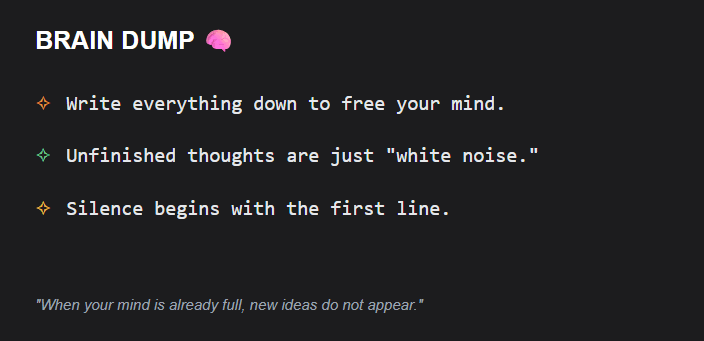
Not a note-taking method in the classroom sense, but the one most people need most often. You write out everything on your mind without sorting it, and only then decide what any of it means. It is for input that is already in your head rather than coming at you from outside.
We have written about this one at length, including what it feels like on a genuinely hard day.
How to choose one
Match the method to the input, not to your personality. Most people need two: one for live capture and one for thinking.
| Situation | Method that fits |
|---|---|
| A lecture or training you will be tested on | Cornell |
| A structured presentation or documented process | Outline |
| A system with many connected parts | Mapping |
| Comparing options against known criteria | Charting |
| Someone talking fast and jumping around | Sentence |
| Planning work that comes in clusters | Boxing |
| Your own head, too full | Brain dump |
Doing this on a computer
Every method above was designed for paper, and three of them survive the move to a screen better than the rest. Cornell needs a two-column layout, which most note apps make awkward; a table with two cells is the usual workaround. Outlining and the sentence method translate directly. Mapping usually needs a dedicated tool.
The useful part of doing it digitally is not the writing, it is the second pass. Search finds a cue column entry six months later in a way that a shelf of notebooks cannot. Whatever you use, pick something that makes revisiting cheap, because every method on this list depends on that pass and every method fails without it.
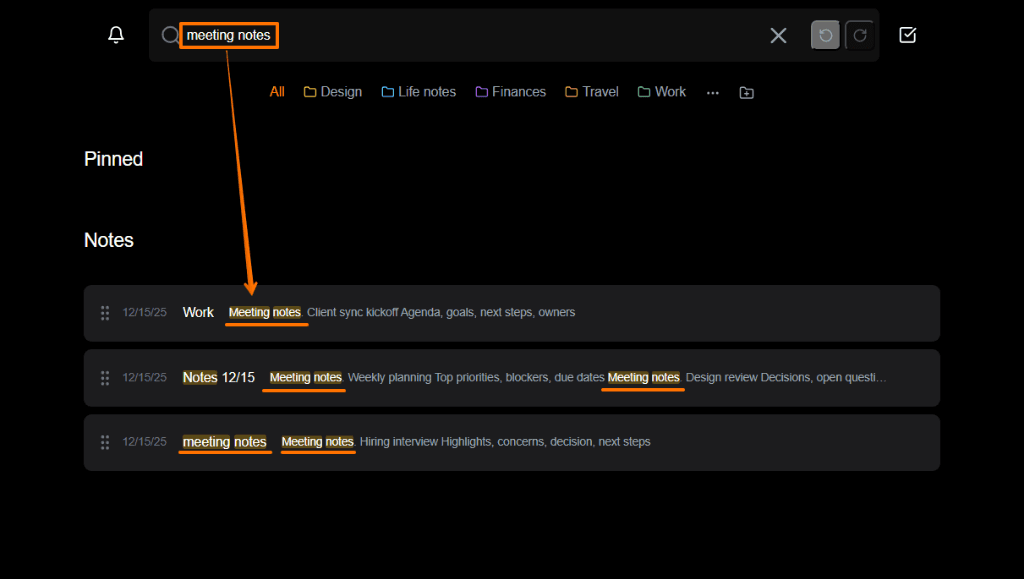
One habit is worth more than everything above. At the end of a note, before you close it, write one line saying what you would want to know if you came across it in a year. It takes fifteen seconds, and it is exactly what the Cornell summary strip does.
Common questions
What is the best note-taking method?
There is not one, and any article that names a single winner is selling something. Cornell is best for material you will be tested on, outlining for structured presentations, mapping for systems with many parts. The method that fits the input beats the method with the best reputation.
How many methods should I actually learn?
Two. One for capturing while something is happening, and one for thinking afterwards. Most people end up with the sentence method for live capture and Cornell or outlining for the material that matters.
Does the Cornell method work for meetings?
Partly. The layout works, but the method depends on a second pass to fill in the cue column, and meetings rarely leave time for it. If you cannot promise yourself that pass, plain notes plus three marked lines will serve you better.
Are digital notes worse than handwritten ones?
The evidence is more mixed than the popular version of it. The best known study found that students who wrote by hand did better on conceptual questions, and a later replication did not reproduce that result. What is not in dispute is retrieval: for finding something again a year later, typed and searchable wins by a wide margin.
Why do my notes never get read again?
Almost always because nothing in the format asks you to. Every method here that works long term has a revisit step built into it. Add one to whatever you already do and it will outperform switching methods.
Source
The handwriting question above refers to Mueller and Oppenheimer, “The Pen Is Mightier Than the Keyboard” (2014).
A 2019 replication by Morehead, Dunlosky and Hartwig did not reproduce the advantage, which is why the answer above says the evidence is mixed rather than settled.
Related reading
- The brain dump method, in full
- Brain dumping with ADHD
- Principles of note-taking organisation
- Daily planning and the log
- Notes and a kanban board together
- TaskNote for Windows
A place to keep them
Notes, a board and reminders in one app. Free to start, no card.
Download for WindowsRecent articles

Comments
Public discussion. Submissions are moderated before they appear.
Loading comments…