
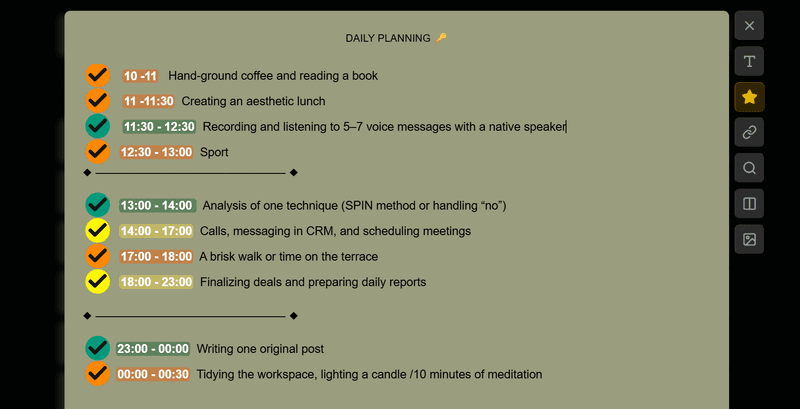
TL;DR: Daily Planning is a repeating template that helps build a balanced daily rhythm. The plan is based on a balance of Action + Recovery + Growth, is limited to about 10 tasks, and serves as a guide. Tasks are divided into Must, Want, and Grow, and color-coding helps quickly spot imbalance.
A Daily Planning system it’s a repeating template that helps you shift focus from "doing everything" to building a balanced daily rhythm.
A Daily Schedule That Adapts to You
- If you tend to overcommit: This plan acts as a filter, helping you focus on essential tasks only.
- If you struggle with procrastination: It provides a gentle daily routine that lowers the friction of starting.
The Secret to a Sustainable Routine
The biggest mistake in time management is planning only for “results” and work.
A truly effective Daily Planning system is a balance of: Action + Recovery + Growth.
How to Structure Your Daily Log (The Three-Tier Method).
1. "Must" (Results-Driven) > Work, commitments, and deadlines. Everything that moves your projects forward.
2. "Want" (Resource-Driven) > Food, movement, breaks, and rest. This is your energy foundation. Without this, the "Must" category fails.
3. "Grow" (Depth & Development) > Learning, reading, or deep conversations. These tasks add meaning and prevent the feeling of "stagnation."
If you highlight each type of task with its own color, it immediately becomes clear which ones dominate the day, for example, only “must” tasks or almost no “want” and “grow.” This helps quickly notice an imbalance.
Core Principles of a Mindful Daily Log Static Template: Your Daily Planning template shouldn't change every day. It’s a recurring anchor.
Static Template: Your Daily Planning template shouldn't change every day. It’s a recurring anchor.
The Power of 10: Aim for ~10 tasks per day to avoid cognitive overload.
Energy First: Start your day with a "Resource" task to build momentum.
Guidance over Rigidity: It’s not necessary to complete everything in the plan; it serves as a guide, not a strict requirement.
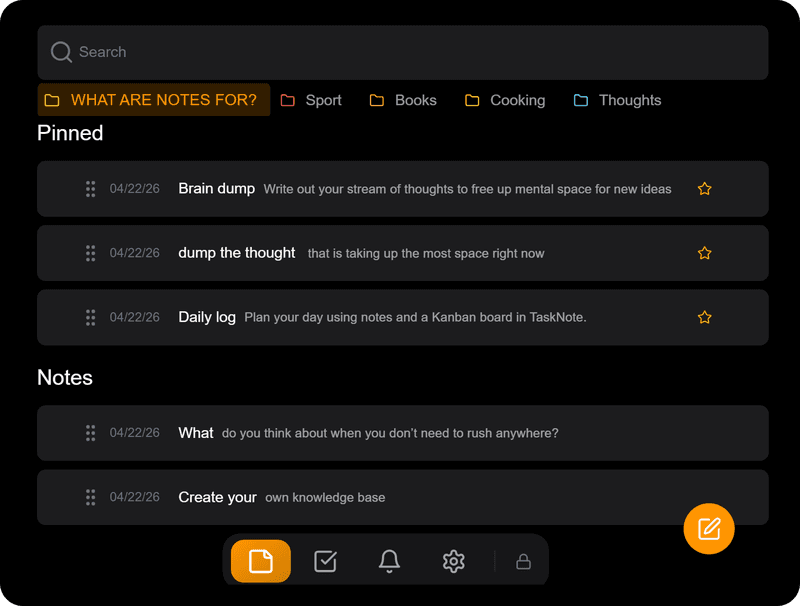
In TaskNote, you can use interactive checkboxes and aesthetic color-coding to track your rhythm. For example, use Soft Pink for "Want," Muted Yellow for "Must," and Sage Green for "Grow."
Aesthetic Template
DAILY PLANNING 🗝️
🟠[00:00 - 00:00] - [task text]
🟢[00:00 - 00:00] - [task text]
🟡[00:00 - 00:00] - [task text]
✧ ────────────────────── ✧
🟠[00:00 - 00:00] - [task text]
🟢[00:00 - 00:00] - [task text]
🟠 Want (Resource-Driven)
🟢 Grow (Depth & Development)
🟡 Must - (Results-Driven)
Recent articles

Comments
Public discussion. Submissions are moderated before they appear.
Loading comments…