
TL;DR
The best notes app for work depends on one thing: whether it fits the way you actually work day to day. For privacy-conscious individuals, TaskNote is the strongest option in 2026. For teams, Notion. For local-first knowledge management, Obsidian. This article breaks down what each does well and how to decide.
What "Best for Work" Actually Means
The best notes app for work is the one you open during a meeting, can search three months later, and does not hand your notes to a third-party server.
Most reviews focus on features. The more useful question is: does this app reduce friction or create it? A note app that takes two seconds to open costs you attention every time you reach for it. A note app with a slow search costs you minutes every day. A note app that stores your work in plaintext on someone else's server costs you trust you cannot get back.
Work notes are different from personal notes. They contain client context, project decisions, action items, and sometimes confidential information. The bar for reliability, speed, and privacy is higher.
Features That Actually Matter at Work
Not every feature in a note app matters for work use. These seven do.
| Feature | Why it matters at work |
|---|---|
| Fast full-text search | You will search more than you browse. Folders are for capture; search is for retrieval. |
| Cross-device sync | A note on your phone should appear on your laptop before the meeting ends. |
| Tasks and reminders alongside notes | Action items live next to the context that created them, not in a separate app. |
| End-to-end encryption | Work notes contain client details, strategy, and personal information. They deserve real privacy. |
| Offline access | Meeting rooms have unreliable Wi-Fi. The app should work without a connection. |
| Structured formatting | Tables, checklists, and code blocks cover most work note types without requiring a heavy editor. |
| Clean export | Your notes should not be locked in. If you switch tools, your archive comes with you. |
Comparison: Top Notes Apps for Work in 2026
Here is how the main apps compare on work-relevant criteria.
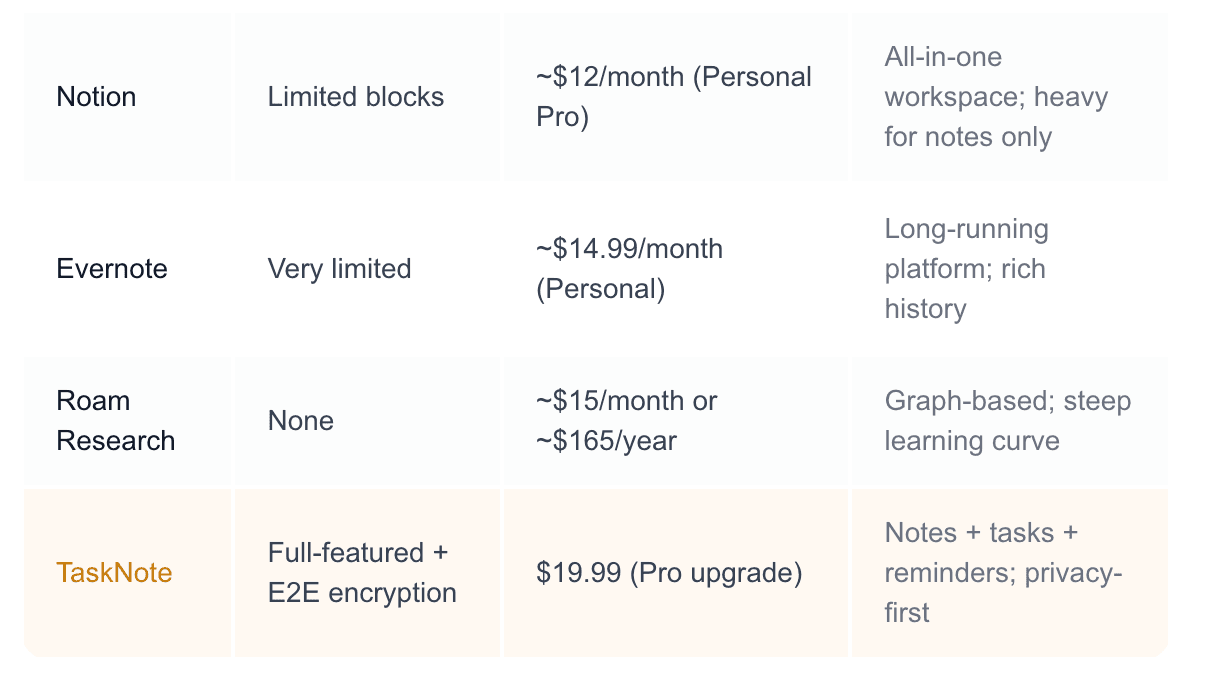
| App | Strengths | Weaknesses | Best for |
|---|---|---|---|
| TaskNote | Privacy, tasks + notes together, fast search | No team collaboration layer | Individual work, privacy-sensitive roles |
| Notion | Team wikis, databases, flexible structure | Heavy for personal notes, slower search | Teams building shared documentation |
| Obsidian | Local-first, powerful linking, large plugin ecosystem | Steep setup, sync costs extra | Researchers and knowledge workers who prefer local storage |
| Evernote | Mature platform, web clipper, cross-platform | Expensive paid plan, slower development | Long-time users with large existing archives |
| Apple Notes | Free, fast, deep Apple integration | Apple ecosystem only, no end-to-end encryption | Apple-only users who want zero friction |
| Google Keep | Free, quick capture, Google Workspace integration | No structure for large archives, no privacy | Quick reminders and short notes inside Google Workspace |
| Bear | Clean editor, markdown, great for writers | Apple-only, no tasks or reminders | Writers and note-takers on Apple devices |
Key observation: most apps optimize for either personal use or team collaboration, but not both. TaskNote focuses on individual work with strong privacy defaults. Notion focuses on teams and shared structure. Pick based on whether your primary need is personal productivity or collaborative documentation.
TaskNote for Work: What Sets It Apart
TaskNote is built around one idea: notes and tasks belong together. At work, context lives next to action. A meeting note that generates three follow-ups should hold those follow-ups in the same place, not scatter them to a separate task manager.
Zero-knowledge encryption
TaskNote encrypts your notes before they leave your device. TaskNote cannot read them. Neither can anyone who gains access to TaskNote's servers. For work involving legal matters, client data, or anything sensitive, this is the correct default. Most other note apps do not offer this.
Tasks and reminders inside notes
You can create a task directly inside a note, set a reminder, and track it without switching apps. The context stays attached. When you revisit the task, you see what it was about without reconstructing it from memory.
Fast search across a large archive
Search in TaskNote is full-text and fast, even across hundreds of notes. Finding something from six months ago takes seconds, not a folder browse.
Works on all platforms
TaskNote runs on Mac, Windows, iOS, and Android. Notes sync across devices reliably. You are not locked into one ecosystem.
How to Organize Work Notes Effectively
A simple structure beats a complex one. Most professionals need three categories, not twenty folders.
Active projects
One note per project or client. Capture decisions, open questions, and action items here. Pin the two or three you return to daily.
Meeting notes
One note per meeting, dated. Include attendees, key decisions, and action items with owners. Do not clean them up during the meeting: capture first, edit after.
Reference material
Recurring information you look up often: processes, credentials format, recurring contacts, templates. This folder grows slowly and stays useful for a long time.
Search handles retrieval better than folders do. The goal of your folder structure is fast capture, not perfect organization. If you are spending time deciding where a note goes, the structure is too complex.
Work Notes and Privacy: What You Should Know
Most popular note apps store notes in a readable format on their servers. That includes Notion, Evernote, and Google Keep. Under their terms of service, the company can access your content for reasons including safety reviews, legal compliance, and product improvement.
For personal grocery lists, this is not a material concern. For notes containing client strategy, financial data, legal advice, or unreleased product plans, it is.
- No encryption: Google Keep, Evernote, Notion, Apple Notes
- Encryption in transit only (standard HTTPS): most apps fall here
- End-to-end encryption (company cannot read notes): TaskNote, Standard Notes, Notesnook
If your work notes contain anything you would not want your vendor to see, use an app in the third category.
Individual Work vs Team Collaboration
The right app depends on whether you are optimizing for personal productivity or shared documentation.
Choose a personal-first app (TaskNote, Bear, Obsidian) when:
- You take and manage your own notes independently
- Privacy and encryption are requirements
- You want tasks and notes in the same place
- You switch between devices and need fast, reliable sync
- Speed and low friction matter more than rich collaboration features
Choose a team-first app (Notion, Confluence) when:
- Multiple people need to edit the same documents
- You are building a shared knowledge base or wiki
- Your team already uses Notion for project management
- You need structured permissions and role-based access
- Real-time collaboration is a daily requirement
Common Mistakes When Choosing a Work Notes App
- Optimizing for looks over speed. A beautiful editor you open slowly is worse than a plain editor you open instantly.
- Using a team tool for personal notes. Notion is excellent for shared wikis. It is heavier than necessary for a single person's daily notes.
- Ignoring export early. The time to verify export quality is before you have 500 notes, not after. Test it during the trial.
- Assuming free apps are private. Free apps are often monetized through data. Check the privacy policy before storing anything sensitive.
- Building too much structure upfront. Deep folder hierarchies slow down capture. Start flat and add structure only when you feel the friction.
Final Recommendation
For individual daily work: TaskNote is the strongest choice in 2026. It combines notes, tasks, and reminders in one place, encrypts everything by default, and runs on all platforms. The free plan is fully functional. The Pro upgrade is a one-time $19.99.
For team documentation: Notion remains the standard for shared wikis and collaborative docs. Use it alongside a personal-first app for your own notes, not instead of one.
For local-first, offline-capable knowledge management: Obsidian is the most powerful option. The setup cost is real, but the flexibility is unmatched for people who want full control over their data.
The best test is a real week of work: import your actual notes, use it in three real meetings, and search for something from last month. If that workflow felt fast and frictionless, you have found the right app.
FAQ
What is the best notes app for work in 2026?
It depends on your workflow. For privacy-focused individual work, TaskNote is the strongest option: end-to-end encryption, tasks and notes together, fast search. For team documentation, Notion works well. For local, offline-first knowledge management, Obsidian is hard to beat. The best app is the one you open consistently every day.
Should I use a separate notes app or just keep notes in my project management tool?
Keeping notes inside your project tool (Jira, Linear, Asana) works for project-specific notes but breaks down for personal knowledge: meeting context, research, drafts, recurring reference material. A dedicated notes app handles the things that don't belong to any one project but still matter for your work.
Is Notion good for work notes?
Notion works well for team wikis and shared documentation. For personal work notes, it can feel heavy: the block editor is slower than a plain text editor, search is less precise, and the free tier limits collaboration. If your team is already in Notion, using it for notes makes sense. If you work solo, a lighter app is usually better.
Are work notes private in most apps?
No. Most major note apps store notes in plaintext on their servers. Notion, Evernote, and Google Keep can read what you write. If your work involves client information, legal matters, or anything sensitive, you need an app with end-to-end encryption. TaskNote uses a zero-knowledge model: your notes are encrypted before they leave your device.
What features matter most in a work notes app?
For work use: fast search across a large archive, reliable sync between devices, the ability to capture tasks and reminders alongside notes, good formatting for structured content, and a privacy model you can trust. Speed matters more than visual polish. If you lose time searching, the app is costing you more than it saves.
How should I organize notes at work?
A simple three-folder structure works for most people: one folder for active projects, one for reference material, and one for meeting notes. Pin the things you return to daily. Use search rather than deep folder hierarchies for retrieval. The goal is capturing fast and finding faster, not building a perfect archive.
Can I use TaskNote for work?
Yes. TaskNote is built around the combination of notes, tasks, and reminders in one place, which is exactly the workflow most people use at work. Notes are end-to-end encrypted, the free plan includes full functionality, and the app works on all platforms. It is particularly strong for people who want private, fast, focused note-taking without a heavy collaboration layer.
近期文章
Comments
Public discussion — submissions are moderated before they appear below.
Discussion
Loading comments…